noesia

EXPERIENCE / ORIGINAL VIEW
Skip to engineering patterns
NOESIA
ENGINEERING SERIES / VOL. 01THE ARCHITECT ↗

Architecture / Security / Automation

INSIDE THE SYSTEMMATRIXX_CODE

10 senior engineering hacks.
WordPress & WooCommerce.
From the inside out.

Architecture, security, automation and commerce patterns designed and applied by Christoph Kanakis inside Matrix X_Code OS.

ARCHITECTURESECURITYAUTOMATIONCOMMERCE
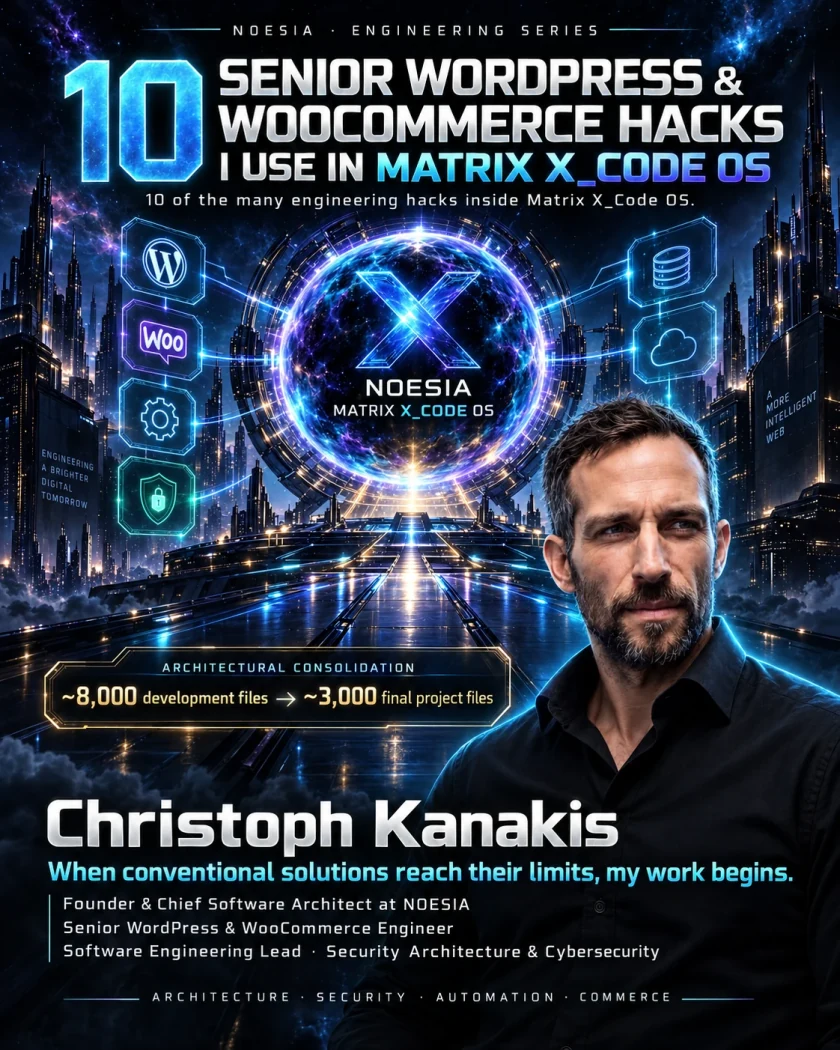
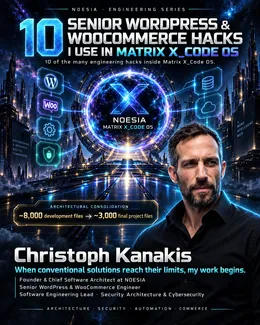
Christoph Kanakis presenting 10 senior WordPress and WooCommerce engineering hacks used in Matrix X_Code OS
10 of the many engineering hacks inside Matrix X_Code OS.
ARCHITECTURAL CONSOLIDATION
~8,000 → ~3,000

development files → final project files

INSIDE THE SERIES
10 engineering patterns

architecture / security / operations

DESIGNED & APPLIED BY
Christoph Kanakis

NOESIA / Matrix X_Code OS

THE ENGINEERING FILES

Open the architecture.

Ten patterns from inside Matrix X_Code OS.
Explore the reasoning. Inspect the code.

01/10 PRODUCTION PATTERN · DATA ACCESS

HPOS-Safe WooCommerce Architecture
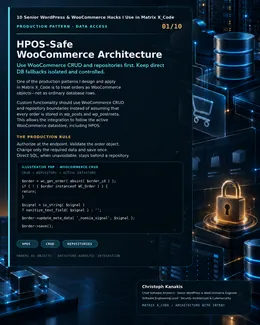
Engineering card: HPOS-safe WooCommerce architecture using CRUD and repository boundaries
Original engineering card 01/10
ILLUSTRATIVE PHP · WOOCOMMERCE CRUD

CRUD → REPOSITORY → ACTIVE DATASTORE

$order = wc_get_order( absint( $order_id ) );
if ( ! ( $order instanceof WC_Order ) ) {
    return;
}
$signal = is_string( $signal )
    ? sanitize_text_field( $signal ) : '';
$order->update_meta_data( '_noesia_signal', $signal );
$order->save();

Why does HPOS change how custom WooCommerce code should access orders?

Direct answer: Orders should be treated as WooCommerce objects. CRUD APIs and repository boundaries allow custom functionality to follow the active WooCommerce datastore, including HPOS, instead of assuming every order is stored in wp_posts and wp_postmeta.

INSIDE THE PATTERN

Use WooCommerce CRUD and repositories first. Keep direct DB fallbacks isolated and controlled.

One of the production patterns I design and apply in Matrix X_Code is to treat orders as WooCommerce objects—not as ordinary database rows.

Custom functionality should use WooCommerce CRUD and repository boundaries instead of assuming that every order is stored in wp_posts and wp_postmeta. This allows the integration to follow the active WooCommerce datastore, including HPOS.

The production rule

Authorize at the endpoint. Validate the order object. Change only the required data and save once. Direct SQL, when unavoidable, stays behind a repository.

Engineering signal Orders as objects · datastore-agnostic integration · controlled persistence

HPOS / CRUD / REPOSITORIES
02/10 PATTERNS I DESIGN AND APPLY

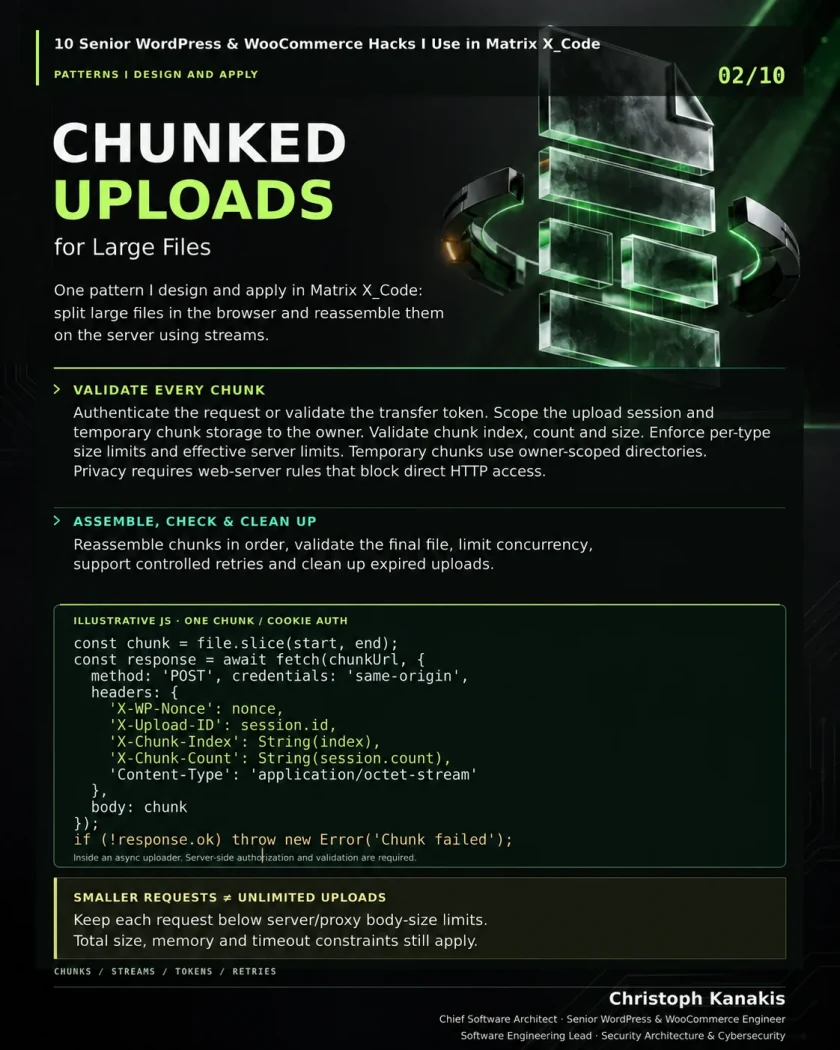
Chunked Uploads for Large Files

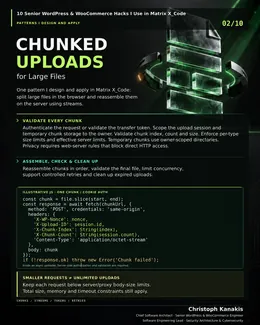
Engineering card: browser chunking and server-side stream reassembly for large files
Original engineering card 02/10
ILLUSTRATIVE JS · ONE CHUNK / COOKIE AUTH
const chunk = file.slice(start, end);
const response = await fetch(chunkUrl, {
  method: 'POST', credentials: 'same-origin',
  headers: {
    'X-WP-Nonce': nonce,
    'X-Upload-ID': session.id,
    'X-Chunk-Index': String(index),
    'X-Chunk-Count': String(session.count),
    'Content-Type': 'application/octet-stream'
  },
  body: chunk
});
if (!response.ok) throw new Error('Chunk failed');

Inside an async uploader. Server-side authorization and validation are required.

How can a web application handle large uploads without sending one oversized request?

Direct answer: Split the file into browser-side chunks, validate every request and chunk, then reassemble the ordered stream on the server. Chunking keeps individual requests below body-size limits, but total-size, memory, timeout and cleanup controls still apply.

INSIDE THE PATTERN

One pattern I design and apply in Matrix X_Code: split large files in the browser and reassemble them on the server using streams.

Validate every chunk

Authenticate the request or validate the transfer token. Scope the upload session and temporary chunk storage to the owner. Validate chunk index, count and size. Enforce per-type size limits and effective server limits. Temporary chunks use owner-scoped directories. Privacy requires web-server rules that block direct HTTP access.

Assemble, check & clean up

Reassemble chunks in order, validate the final file, limit concurrency, support controlled retries and clean up expired uploads.

Smaller requests ≠ unlimited uploads Keep each request below server/proxy body-size limits. Total size, memory and timeout constraints still apply.

CHUNKS / STREAMS / TOKENS / RETRIES

03/10 PATTERNS I DESIGN AND APPLY · SMART WAITER

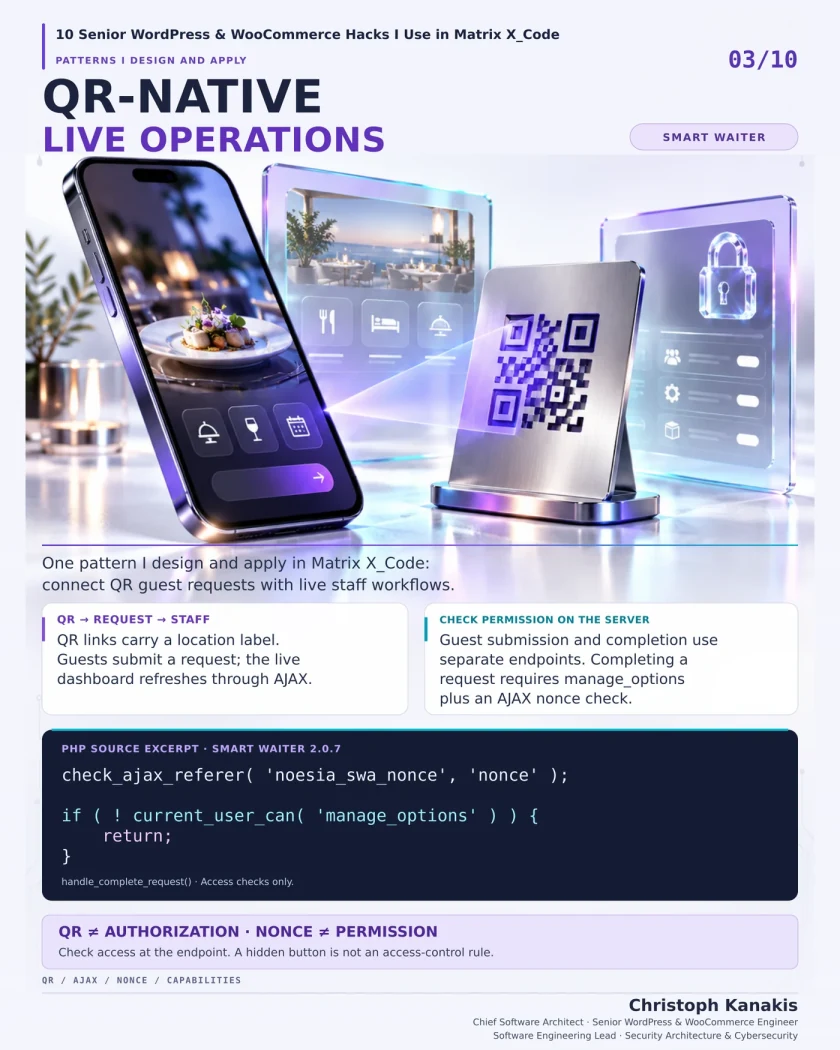
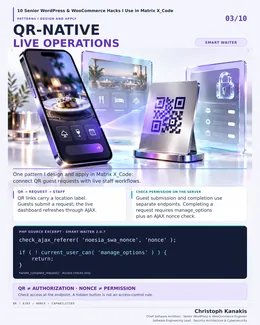
QR-Native Live Operations

Engineering card: QR-native guest requests connected to live staff workflows in NOESIA Smart Waiter
Original engineering card 03/10
PHP SOURCE EXCERPT · SMART WAITER 2.0.7
check_ajax_referer( 'noesia_swa_nonce', 'nonce' );
if ( ! current_user_can( 'manage_options' ) ) {
    return;
}

handle_complete_request() · Access checks only.

Is scanning a QR code enough to authorize a staff action?

Direct answer: No. A QR link may identify the request location, but authorization must be checked at the server endpoint. Guest submission and staff completion use separate endpoints, and completion requires the appropriate capability plus a valid AJAX nonce.

INSIDE THE PATTERN

One pattern I design and apply in Matrix X_Code: connect QR guest requests with live staff workflows.

QR → request → staff

QR links carry a location label. Guests submit a request; the live dashboard refreshes through AJAX.

Check permission on the server

Guest submission and completion use separate endpoints. Completing a request requires manage_options plus an AJAX nonce check.

QR ≠ authorization · nonce ≠ permission Check access at the endpoint. A hidden button is not an access-control rule.

QR / AJAX / NONCE / CAPABILITIES

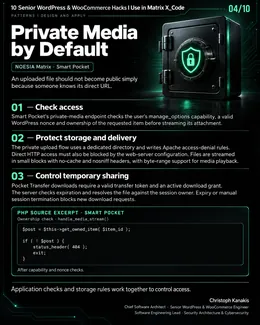
04/10 NOESIA MATRIX · SMART POCKET

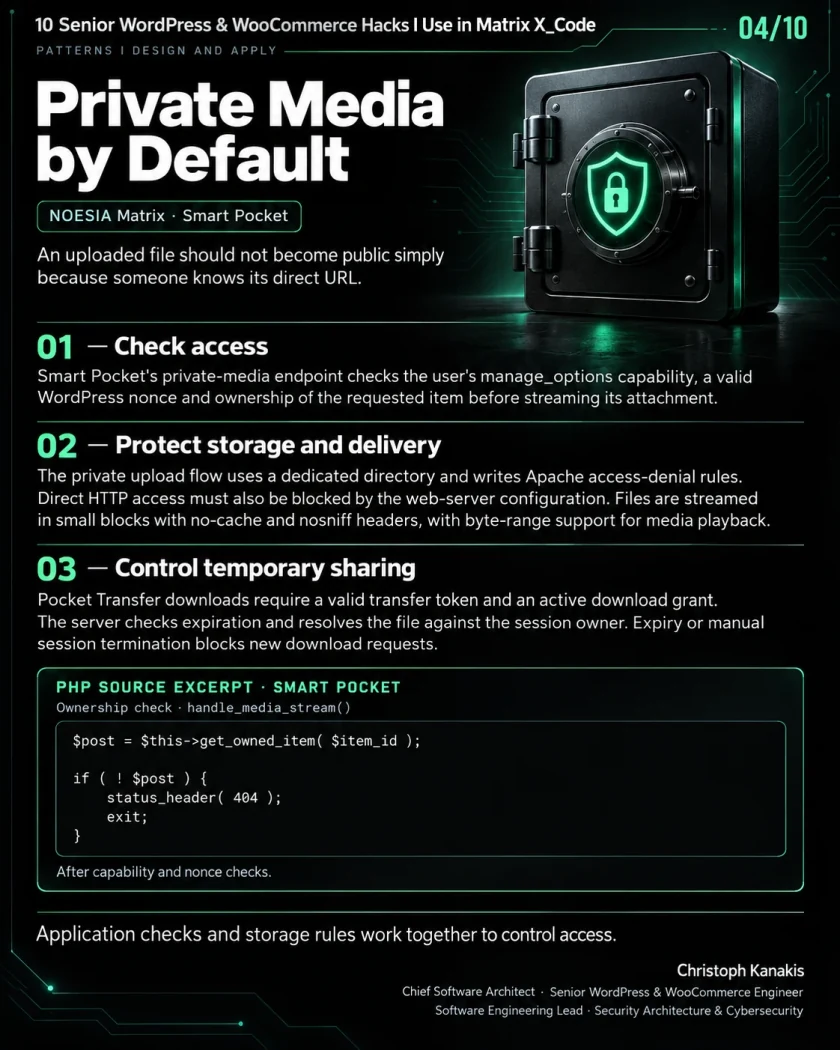
Private Media by Default

Engineering card: private media access, protected storage and controlled temporary sharing
Original engineering card 04/10
PHP SOURCE EXCERPT · SMART POCKET

Ownership check · handle_media_stream()

$post = $this->get_owned_item( $item_id );
if ( ! $post ) {
    status_header( 404 );
    exit;
}

After capability and nonce checks.

How do you prevent a private WordPress attachment from becoming public through its direct URL?

Direct answer: Access checks and storage rules must work together. Verify capability, nonce and ownership in the application; block direct HTTP access at the web-server layer; then stream authorized files with appropriate response headers.

INSIDE THE PATTERN

An uploaded file should not become public simply because someone knows its direct URL.

01 — Check access

Smart Pocket's private-media endpoint checks the user's manage_options capability, a valid WordPress nonce and ownership of the requested item before streaming its attachment.

02 — Protect storage and delivery

The private upload flow uses a dedicated directory and writes Apache access-denial rules. Direct HTTP access must also be blocked by the web-server configuration. Files are streamed in small blocks with no-cache and nosniff headers, with byte-range support for media playback.

03 — Control temporary sharing

Pocket Transfer downloads require a valid transfer token and an active download grant. The server checks expiration and resolves the file against the session owner. Expiry or manual session termination blocks new download requests.

Layered access control Application checks and storage rules work together to control access.

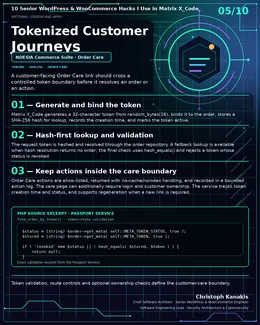
05/10 NOESIA COMMERCE SUITE · ORDER CARE

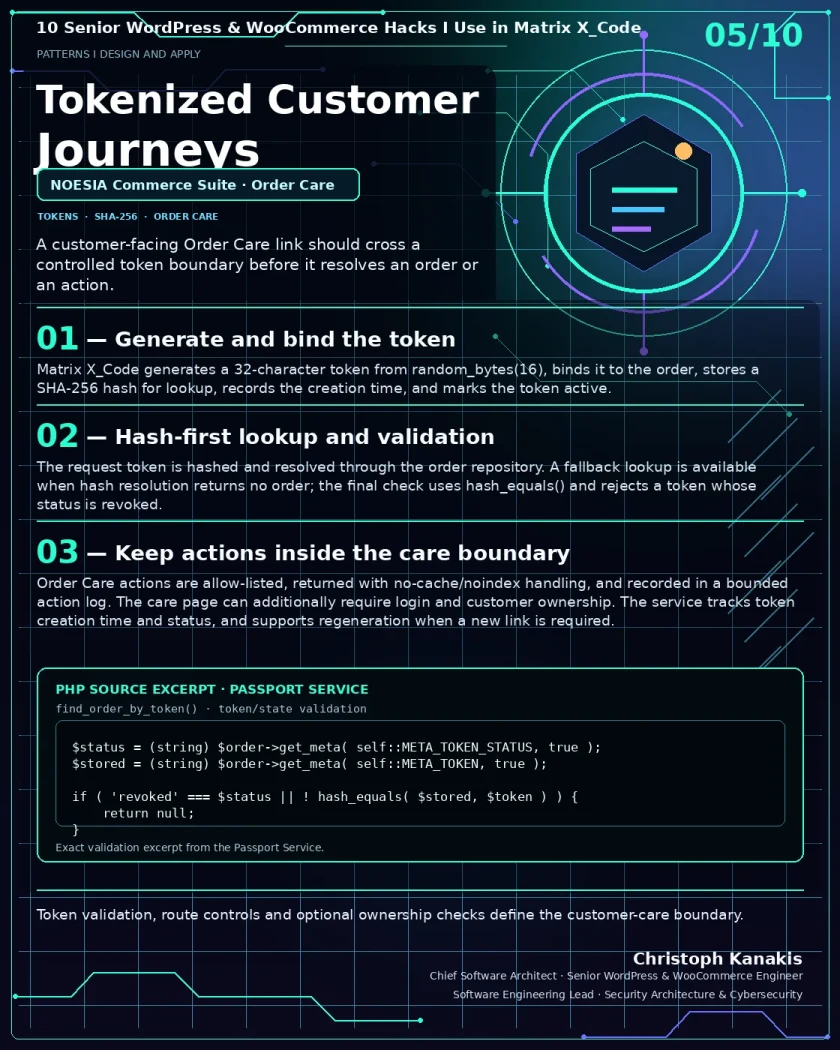
Tokenized Customer Journeys

Engineering card: tokenized customer-facing Order Care journeys in NOESIA Commerce Suite
Original engineering card 05/10
PHP SOURCE EXCERPT · PASSPORT SERVICE

find_order_by_token() · token/state validation

$status = (string) $order->get_meta( self::META_TOKEN_STATUS, true );
$stored = (string) $order->get_meta( self::META_TOKEN, true );
if ( 'revoked' === $status || ! hash_equals( $stored, $token ) ) {
    return null;
}

Exact validation excerpt from the Passport Service.

How should a customer-facing order link resolve an order or action safely?

Direct answer: The link should cross a controlled token boundary. Generate and bind a high-entropy token, resolve it through a hash-first lookup, validate its state with a timing-safe comparison, and keep allowed actions within a bounded Order Care service.

INSIDE THE PATTERN

TOKENS · SHA-256 · ORDER CARE

A customer-facing Order Care link should cross a controlled token boundary before it resolves an order or an action.

01 — Generate and bind the token

Matrix X_Code generates a 32-character token from random_bytes(16), binds it to the order, stores a SHA-256 hash for lookup, records the creation time, and marks the token active.

02 — Hash-first lookup and validation

The request token is hashed and resolved through the order repository. A fallback lookup is available when hash resolution returns no order; the final check uses hash_equals() and rejects a token whose status is revoked.

03 — Keep actions inside the care boundary

Order Care actions are allow-listed, returned with no-cache/noindex handling, and recorded in a bounded action log. The care page can additionally require login and customer ownership. The service tracks token creation time and status, and supports regeneration when a new link is required.

Controlled customer-care boundary Token validation, route controls and optional ownership checks define access.

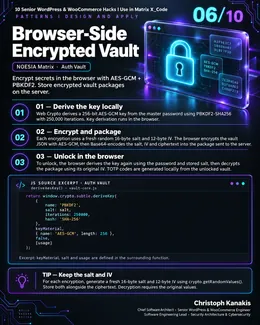
06/10 NOESIA MATRIX · AUTH VAULT

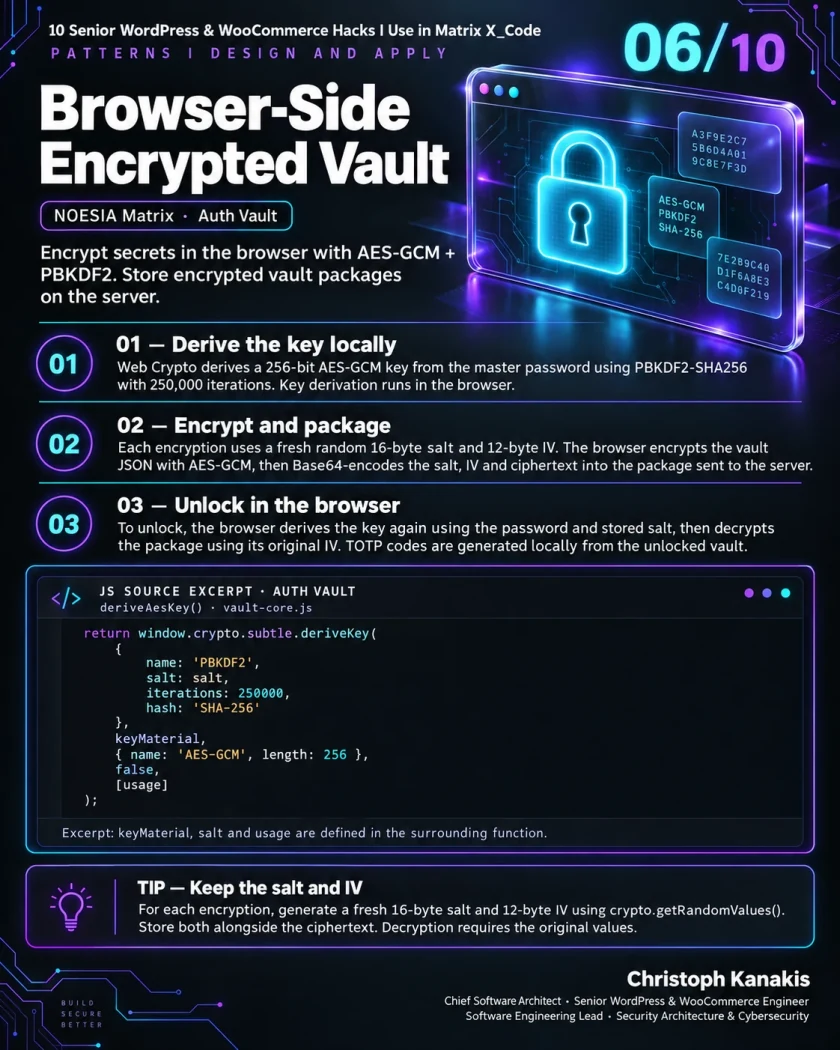
Browser-Side Encrypted Vault

Engineering card: browser-side encrypted vault using AES-GCM and PBKDF2
Original engineering card 06/10
JS SOURCE EXCERPT · AUTH VAULT

deriveAesKey() · vault-core.js

return window.crypto.subtle.deriveKey(
  {
    name: 'PBKDF2',
    salt: salt,
    iterations: 250000,
    hash: 'SHA-256'
  },
  keyMaterial,
  { name: 'AES-GCM', length: 256 },
  false,
  [usage]
);

Excerpt: keyMaterial, salt and usage are defined in the surrounding function.

How can vault data be encrypted before it reaches the server?

Direct answer: Derive an AES-GCM key locally from the master password with PBKDF2-SHA256, encrypt the vault JSON inside the browser, and send only the encoded salt, IV and ciphertext package to the server.

INSIDE THE PATTERN

Encrypt secrets in the browser with AES-GCM + PBKDF2. Store encrypted vault packages on the server.

01 — Derive the key locally

Web Crypto derives a 256-bit AES-GCM key from the master password using PBKDF2-SHA256 with 250,000 iterations. Key derivation runs in the browser.

02 — Encrypt and package

Each encryption uses a fresh random 16-byte salt and 12-byte IV. The browser encrypts the vault JSON with AES-GCM, then Base64-encodes the salt, IV and ciphertext into the package sent to the server.

03 — Unlock in the browser

To unlock, the browser derives the key again using the password and stored salt, then decrypts the package using its original IV. TOTP codes are generated locally from the unlocked vault.

Keep the salt and IV Generate a fresh 16-byte salt and 12-byte IV using crypto.getRandomValues(). Store both alongside the ciphertext. Decryption requires the original values.

BUILD / SECURE / BETTER

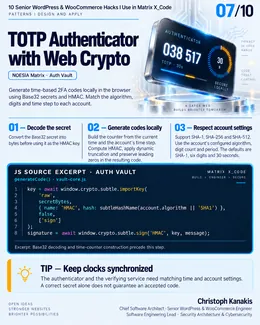
07/10 NOESIA MATRIX · AUTH VAULT

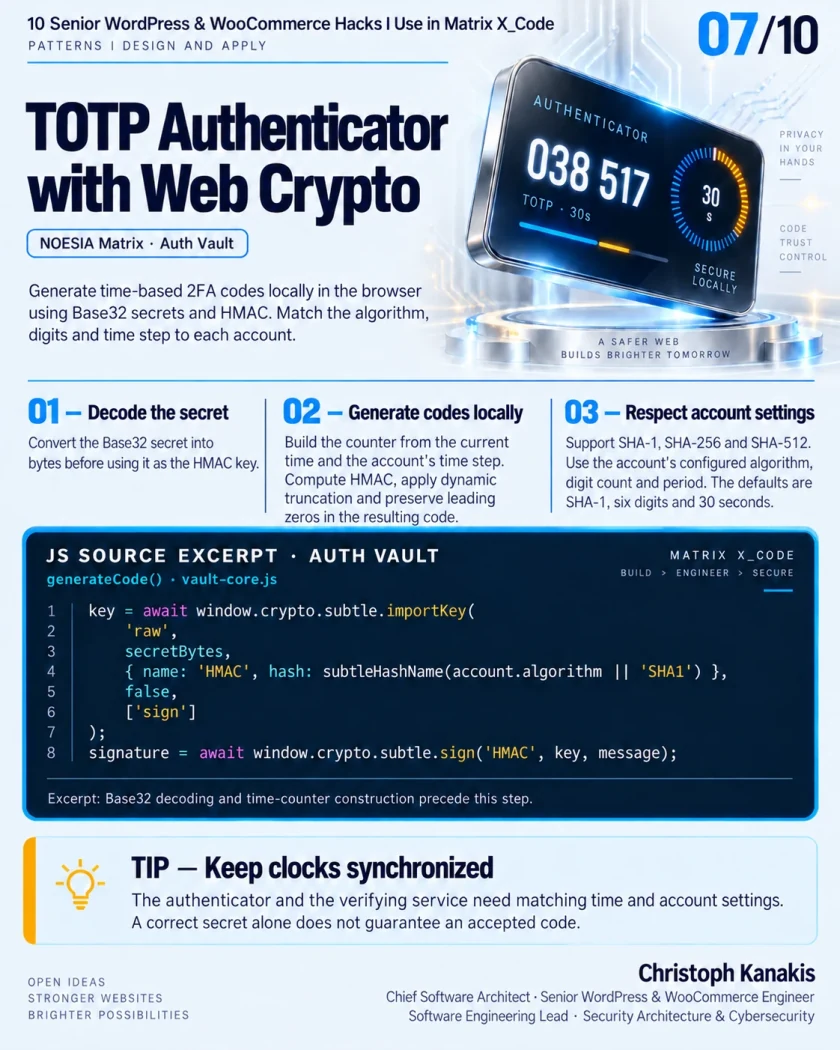
TOTP Authenticator with Web Crypto

Engineering card: local TOTP generation with Base32 secrets, HMAC and Web Crypto
Original engineering card 07/10
JS SOURCE EXCERPT · AUTH VAULT

generateCode() · vault-core.js

key = await window.crypto.subtle.importKey(
  'raw',
  secretBytes,
  { name: 'HMAC', hash: subtleHashName(account.algorithm || 'SHA1') },
  false,
  ['sign']
);
signature = await window.crypto.subtle.sign('HMAC', key, message);

Excerpt: Base32 decoding and time-counter construction precede this step.

How can a browser generate TOTP codes locally?

Direct answer: Decode the account's Base32 secret, build a time counter using the configured period, compute HMAC with the account's algorithm, then apply dynamic truncation and preserve the configured number of digits.

INSIDE THE PATTERN

Generate time-based 2FA codes locally in the browser using Base32 secrets and HMAC. Match the algorithm, digits and time step to each account.

01 — Decode the secret

Convert the Base32 secret into bytes before using it as the HMAC key.

02 — Generate codes locally

Build the counter from the current time and the account's time step. Compute HMAC, apply dynamic truncation and preserve leading zeros in the resulting code.

03 — Respect account settings

Support SHA-1, SHA-256 and SHA-512. Use the account's configured algorithm, digit count and period. The defaults are SHA-1, six digits and 30 seconds.

Keep clocks synchronized The authenticator and the verifying service need matching time and account settings. A correct secret alone does not guarantee an accepted code.

PRIVACY IN YOUR HANDS // CODE · TRUST · CONTROL // A SAFER WEB BUILDS A BRIGHTER TOMORROW // OPEN IDEAS · STRONGER WEBSITES · BRIGHTER POSSIBILITIES

08/10 APPLICATION SECURITY · NOESIA MATRIX · RECOVERY CONTACTS

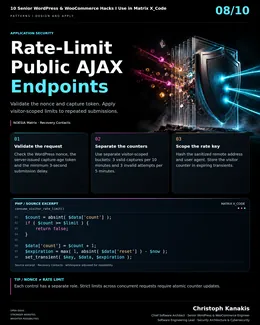
Rate-Limit Public AJAX Endpoints

Engineering card: visitor-scoped rate limiting for public WordPress AJAX endpoints
Original engineering card 08/10
PHP / SOURCE EXCERPT · RECOVERY CONTACTS

consume_visitor_rate_limit()

$count = absint( $data['count'] );
if ( $count >= $limit ) {
    return false;
}
$data['count'] = $count + 1;
$expiration = max( 1, absint( $data['reset'] ) - $now );
set_transient( $key, $data, $expiration );

Source excerpt · Recovery Contacts · whitespace adjusted for readability.

Why is a WordPress nonce not a replacement for rate limiting?

Direct answer: A nonce helps validate request intent, while a rate limit controls repeated submissions. Public AJAX endpoints should validate request tokens and also apply separate, expiring visitor-scoped counters according to the action and risk.

INSIDE THE PATTERN

Validate the nonce and capture token. Apply visitor-scoped limits to repeated submissions.

01 — Validate the request

Check the WordPress nonce, the server-issued capture-age token and the minimum 3-second submission delay.

02 — Separate the counters

Use separate visitor-scoped buckets: 3 valid captures per 10 minutes and 3 invalid attempts per 5 minutes.

03 — Scope the rate key

Hash the sanitized remote address and user agent. Store the visitor counter in expiring transients.

Nonce ≠ rate limit Each control has a separate role. Strict limits across concurrent requests require atomic counter updates.

OPEN IDEAS · STRONGER WEBSITES · BRIGHTER POSSIBILITIES

09/10 MODULAR ARCHITECTURE · NOESIA MATRIX · COMMERCE SUITE

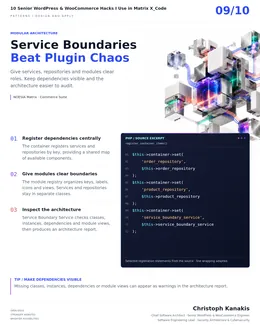
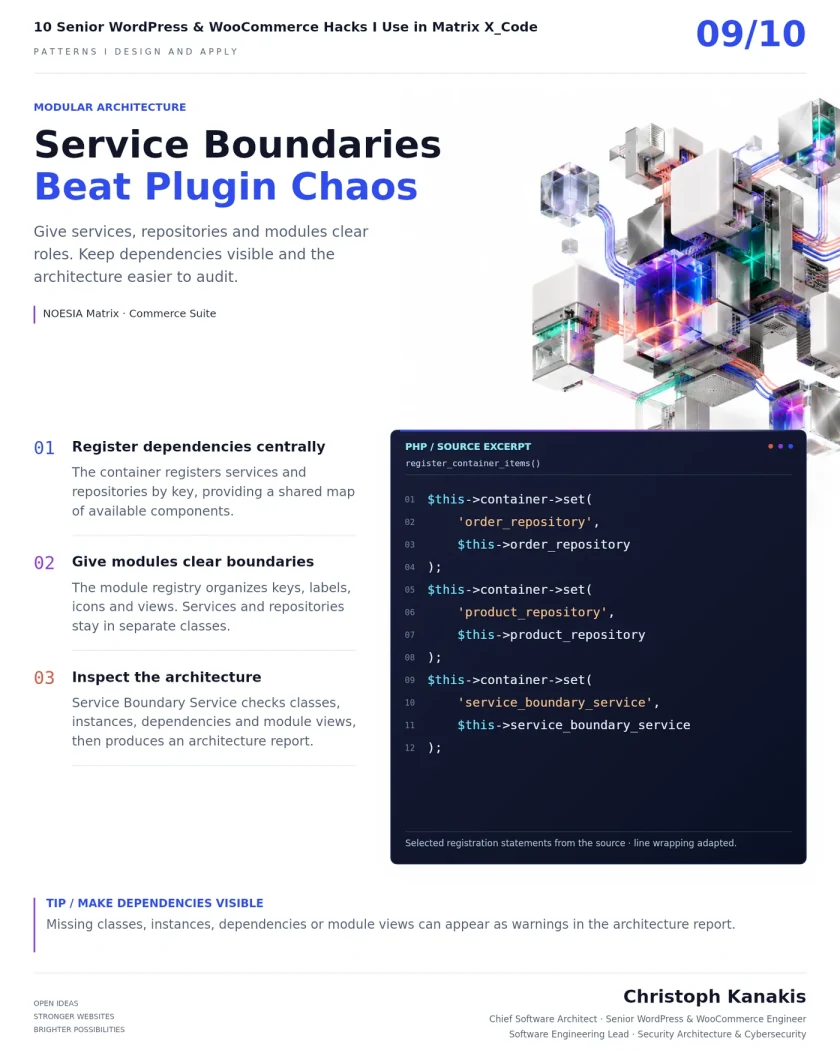
Service Boundaries Beat Plugin Chaos

Engineering card: modular WordPress architecture with visible service, repository and module boundaries
Original engineering card 09/10
PHP / SOURCE EXCERPT

register_container_items()

$this->container->set(
    'order_repository',
    $this->order_repository
);
$this->container->set(
    'product_repository',
    $this->product_repository
);
$this->container->set(
    'service_boundary_service',
    $this->service_boundary_service
);

Selected registration statements from the source · line wrapping adapted.

How do service boundaries make a large WordPress system easier to maintain and audit?

Direct answer: Give services, repositories and modules explicit roles, register their dependencies centrally, and inspect the resulting component map. The architecture becomes easier to reason about because responsibilities and missing dependencies remain visible.

INSIDE THE PATTERN

Give services, repositories and modules clear roles. Keep dependencies visible and the architecture easier to audit.

01 — Register dependencies centrally

The container registers services and repositories by key, providing a shared map of available components.

02 — Give modules clear boundaries

The module registry organizes keys, labels, icons and views. Services and repositories stay in separate classes.

03 — Inspect the architecture

Service Boundary Service checks classes, instances, dependencies and module views, then produces an architecture report.

Make dependencies visible Missing classes, instances, dependencies or module views can appear as warnings in the architecture report.

OPEN IDEAS · STRONGER WEBSITES · BRIGHTER POSSIBILITIES

10/10 WITHOUT CHECKOUT DAMAGE · NOESIA MATRIX · CHECKOUT CONFIDENCE

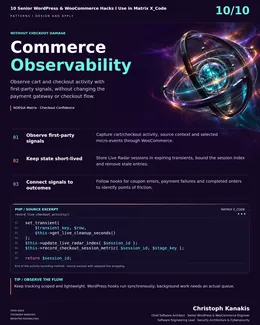
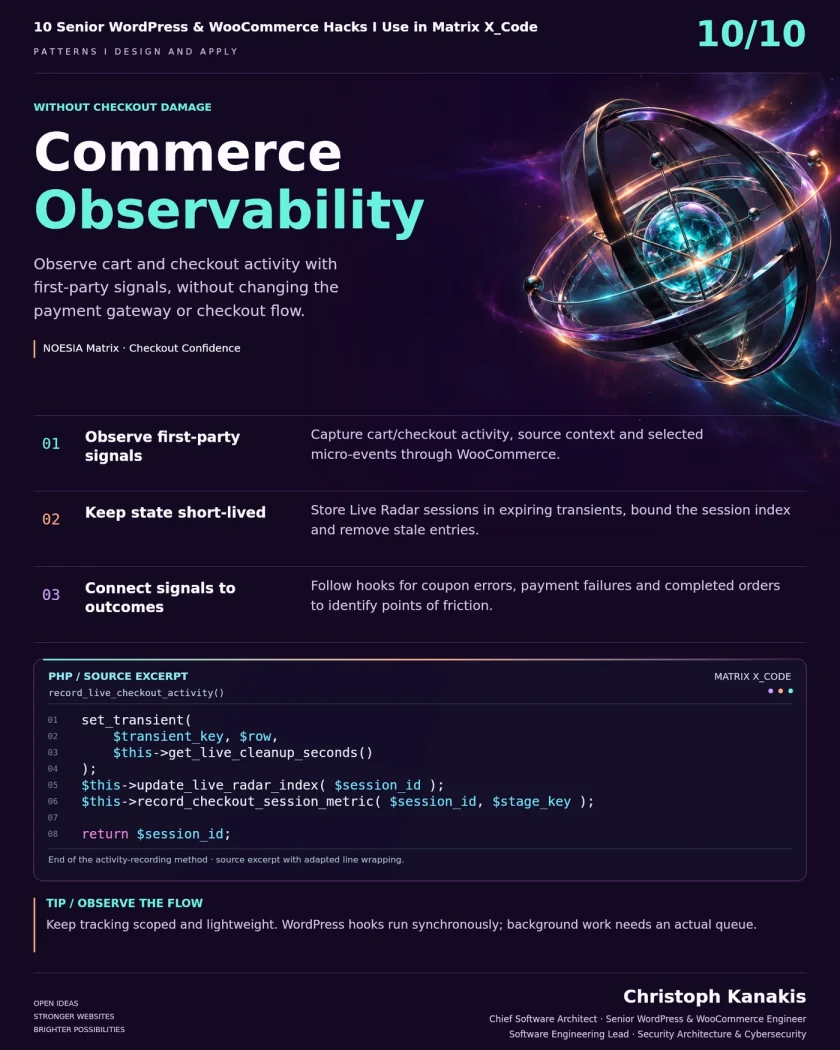
Commerce Observability

Engineering card: scoped first-party cart and checkout observability in WooCommerce
Original engineering card 10/10
PHP / SOURCE EXCERPT · CHECKOUT CONFIDENCE

record_live_checkout_activity()

set_transient(
    $transient_key, $row,
    $this->get_live_cleanup_seconds()
);
$this->update_live_radar_index( $session_id );
$this->record_checkout_session_metric( $session_id, $stage_key );
return $session_id;

End of the activity-recording method · source excerpt with adapted line wrapping.

How can WooCommerce checkout activity be observed without changing the payment gateway or checkout flow?

Direct answer: Capture narrowly scoped first-party cart and checkout signals through WooCommerce, keep session state short-lived, and connect selected micro-events to outcomes such as coupon errors, payment failures and completed orders.

INSIDE THE PATTERN

WITHOUT CHECKOUT DAMAGE

Observe cart and checkout activity with first-party signals, without changing the payment gateway or checkout flow.

01 — Observe first-party signals

Capture cart/checkout activity, source context and selected micro-events through WooCommerce.

02 — Keep state short-lived

Store Live Radar sessions in expiring transients, bound the session index and remove stale entries.

03 — Connect signals to outcomes

Follow hooks for coupon errors, payment failures and completed orders to identify points of friction.

Observe the flow Keep tracking scoped and lightweight. WordPress hooks run synchronously; background work needs an actual queue.

OPEN IDEAS · STRONGER WEBSITES · BRIGHTER POSSIBILITIES

THE MATRIX X_CODE ENGINEERING PHILOSOPHY

Architecture with intent.
Security by design.

01

Boundaries before complexity

Make components, responsibilities and access paths explicit before a system grows.

02

Controls with separate roles

Authentication, authorization, validation, storage protection and rate limiting solve different problems.

03

Observable, controlled operations

Capture only the signals required to understand a workflow, then keep state bounded and short-lived.

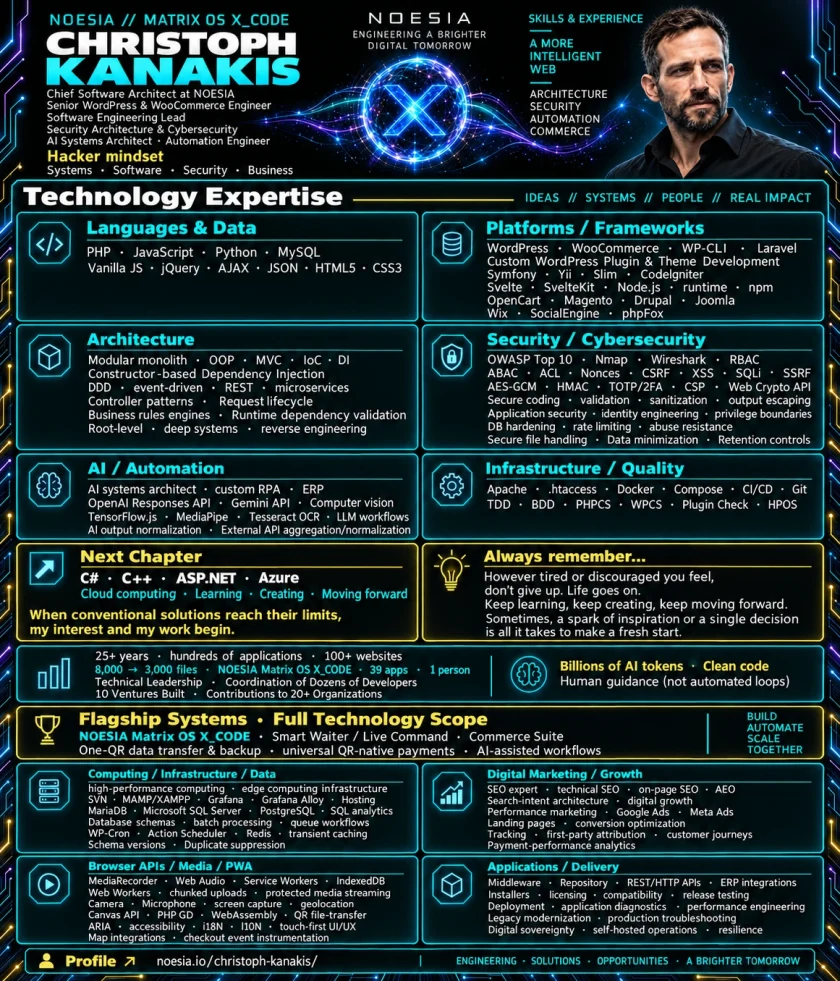
Christoph Kanakis technology expertise map across software architecture, cybersecurity, AI, automation, infrastructure and digital growth

AUTHOR SYSTEMS · SOFTWARE · SECURITY · BUSINESS

Christoph Kanakis

Founder & Chief Software Architect at NOESIA
Senior WordPress & WooCommerce Engineer
Software Engineering Lead · Security Architecture & Cybersecurity
AI Systems Architect · Automation Engineer

NOESIA // MATRIX OS X_CODE // SKILLS & EXPERIENCE // A MORE INTELLIGENT WEB // IDEAS · SYSTEMS · PEOPLE · REAL IMPACT // HACKER MINDSET

“When conventional solutions reach their limits, my work begins.”

This engineering series presents ten of the production patterns designed and applied inside Matrix X_Code OS—part of a wider body of work across architecture, security, automation and commerce.

TECHNOLOGY EXPERTISE / FULL MATRIX +

Languages & Data

PHP · JavaScript · Python · MySQL

Vanilla JS · jQuery · AJAX · JSON · HTML5 · CSS3

Platforms / Frameworks

WordPress · WooCommerce · WP-CLI · Laravel

Custom WordPress Plugin & Theme Development

Symfony · Yii · Slim · CodeIgniter

Svelte · SvelteKit · Node.js · runtime · npm

OpenCart · Magento · Drupal · Joomla

Wix · SocialEngine · phpFox

Architecture

Modular monolith · OOP · MVC · IoC · DI

Constructor-based Dependency Injection

DDD · event-driven · REST · microservices

Controller patterns · Request lifecycle

Business rules engines · Runtime dependency validation

Root-level · deep systems · reverse engineering

Security / Cybersecurity

OWASP Top 10 · Nmap · Wireshark · RBAC

ABAC · ACL · Nonces · CSRF · XSS · SQLi · SSRF

AES-GCM · HMAC · TOTP/2FA · CSP · Web Crypto API

Secure coding · validation · sanitization · output escaping

Application security · identity engineering · privilege boundaries

DB hardening · rate limiting · abuse resistance

Secure file handling · Data minimization · Retention controls

AI / Automation

AI systems architect · custom RPA · ERP

OpenAI Responses API · Gemini API · Computer vision

TensorFlow.js · MediaPipe · Tesseract OCR · LLM workflows

AI output normalization · External API aggregation/normalization

Infrastructure / Quality

Apache · .htaccess · Docker · Compose · CI/CD · Git

TDD · BDD · PHPCS · WPCS · Plugin Check · HPOS

Next Chapter

C# · C++ · ASP.NET · Azure

Cloud computing · Learning · Creating · Moving forward

Always remember...

However tired or discouraged you feel.

KEEP BUILDING
Click image for original size.
Esc to close.
Skip to engineering patterns

NOESIA // ENGINEERING SERIES

Inside Matrix X_Code:
10 Senior WordPress & WooCommerce Engineering Hacks

Architecture, security, automation and commerce patterns designed and applied by Christoph Kanakis inside Matrix X_Code OS.

ORIGINAL SERIES // 10 Senior WordPress & WooCommerce Hacks I Use in Matrix X_Code OS

ARCHITECTURAL CONSOLIDATION ~8,000 development files → ~3,000 final project files
ARCHITECTURESECURITYAUTOMATIONCOMMERCE
matrix-x-code://engineering-audit

root@noesia:~$

Ten production engineering patterns loaded successfully.

Christoph Kanakis presenting 10 senior WordPress and WooCommerce engineering hacks used in Matrix X_Code OS
10 of the many engineering hacks inside Matrix X_Code OS.
Engineering card: HPOS-safe WooCommerce architecture using CRUD and repository boundaries
Original engineering card 01/10

01/10 PRODUCTION PATTERN · DATA ACCESS

HPOS-Safe WooCommerce Architecture

Why does HPOS change how custom WooCommerce code should access orders?

Direct answer: Orders should be treated as WooCommerce objects. CRUD APIs and repository boundaries allow custom functionality to follow the active WooCommerce datastore, including HPOS, instead of assuming every order is stored in wp_posts and wp_postmeta.

Original engineering card content

Use WooCommerce CRUD and repositories first. Keep direct DB fallbacks isolated and controlled.

One of the production patterns I design and apply in Matrix X_Code is to treat orders as WooCommerce objects—not as ordinary database rows.

Custom functionality should use WooCommerce CRUD and repository boundaries instead of assuming that every order is stored in wp_posts and wp_postmeta. This allows the integration to follow the active WooCommerce datastore, including HPOS.

The production rule

Authorize at the endpoint. Validate the order object. Change only the required data and save once. Direct SQL, when unavoidable, stays behind a repository.

ILLUSTRATIVE PHP · WOOCOMMERCE CRUD

CRUD → REPOSITORY → ACTIVE DATASTORE

$order = wc_get_order( absint( $order_id ) );
if ( ! ( $order instanceof WC_Order ) ) {
    return;
}
$signal = is_string( $signal )
    ? sanitize_text_field( $signal ) : '';
$order->update_meta_data( '_noesia_signal', $signal );
$order->save();

Engineering signal Orders as objects · datastore-agnostic integration · controlled persistence

HPOS / CRUD / REPOSITORIES
Engineering card: browser chunking and server-side stream reassembly for large files
Original engineering card 02/10

02/10 PATTERNS I DESIGN AND APPLY

Chunked Uploads for Large Files

How can a web application handle large uploads without sending one oversized request?

Direct answer: Split the file into browser-side chunks, validate every request and chunk, then reassemble the ordered stream on the server. Chunking keeps individual requests below body-size limits, but total-size, memory, timeout and cleanup controls still apply.

Original engineering card content

One pattern I design and apply in Matrix X_Code: split large files in the browser and reassemble them on the server using streams.

Validate every chunk

Authenticate the request or validate the transfer token. Scope the upload session and temporary chunk storage to the owner. Validate chunk index, count and size. Enforce per-type size limits and effective server limits. Temporary chunks use owner-scoped directories. Privacy requires web-server rules that block direct HTTP access.

Assemble, check & clean up

Reassemble chunks in order, validate the final file, limit concurrency, support controlled retries and clean up expired uploads.

ILLUSTRATIVE JS · ONE CHUNK / COOKIE AUTH
const chunk = file.slice(start, end);
const response = await fetch(chunkUrl, {
  method: 'POST', credentials: 'same-origin',
  headers: {
    'X-WP-Nonce': nonce,
    'X-Upload-ID': session.id,
    'X-Chunk-Index': String(index),
    'X-Chunk-Count': String(session.count),
    'Content-Type': 'application/octet-stream'
  },
  body: chunk
});
if (!response.ok) throw new Error('Chunk failed');

Inside an async uploader. Server-side authorization and validation are required.

Smaller requests ≠ unlimited uploads Keep each request below server/proxy body-size limits. Total size, memory and timeout constraints still apply.

CHUNKS / STREAMS / TOKENS / RETRIES

Engineering card: QR-native guest requests connected to live staff workflows in NOESIA Smart Waiter
Original engineering card 03/10

03/10 PATTERNS I DESIGN AND APPLY · SMART WAITER

QR-Native Live Operations

Is scanning a QR code enough to authorize a staff action?

Direct answer: No. A QR link may identify the request location, but authorization must be checked at the server endpoint. Guest submission and staff completion use separate endpoints, and completion requires the appropriate capability plus a valid AJAX nonce.

Original engineering card content

One pattern I design and apply in Matrix X_Code: connect QR guest requests with live staff workflows.

QR → request → staff

QR links carry a location label. Guests submit a request; the live dashboard refreshes through AJAX.

Check permission on the server

Guest submission and completion use separate endpoints. Completing a request requires manage_options plus an AJAX nonce check.

PHP SOURCE EXCERPT · SMART WAITER 2.0.7
check_ajax_referer( 'noesia_swa_nonce', 'nonce' );
if ( ! current_user_can( 'manage_options' ) ) {
    return;
}

handle_complete_request() · Access checks only.

QR ≠ authorization · nonce ≠ permission Check access at the endpoint. A hidden button is not an access-control rule.

QR / AJAX / NONCE / CAPABILITIES

Engineering card: private media access, protected storage and controlled temporary sharing
Original engineering card 04/10

04/10 NOESIA MATRIX · SMART POCKET

Private Media by Default

How do you prevent a private WordPress attachment from becoming public through its direct URL?

Direct answer: Access checks and storage rules must work together. Verify capability, nonce and ownership in the application; block direct HTTP access at the web-server layer; then stream authorized files with appropriate response headers.

Original engineering card content

An uploaded file should not become public simply because someone knows its direct URL.

01 — Check access

Smart Pocket's private-media endpoint checks the user's manage_options capability, a valid WordPress nonce and ownership of the requested item before streaming its attachment.

02 — Protect storage and delivery

The private upload flow uses a dedicated directory and writes Apache access-denial rules. Direct HTTP access must also be blocked by the web-server configuration. Files are streamed in small blocks with no-cache and nosniff headers, with byte-range support for media playback.

03 — Control temporary sharing

Pocket Transfer downloads require a valid transfer token and an active download grant. The server checks expiration and resolves the file against the session owner. Expiry or manual session termination blocks new download requests.

PHP SOURCE EXCERPT · SMART POCKET

Ownership check · handle_media_stream()

$post = $this->get_owned_item( $item_id );
if ( ! $post ) {
    status_header( 404 );
    exit;
}

After capability and nonce checks.

Layered access control Application checks and storage rules work together to control access.

Engineering card: tokenized customer-facing Order Care journeys in NOESIA Commerce Suite
Original engineering card 05/10

05/10 NOESIA COMMERCE SUITE · ORDER CARE

Tokenized Customer Journeys

How should a customer-facing order link resolve an order or action safely?

Direct answer: The link should cross a controlled token boundary. Generate and bind a high-entropy token, resolve it through a hash-first lookup, validate its state with a timing-safe comparison, and keep allowed actions within a bounded Order Care service.

Original engineering card content

TOKENS · SHA-256 · ORDER CARE

A customer-facing Order Care link should cross a controlled token boundary before it resolves an order or an action.

01 — Generate and bind the token

Matrix X_Code generates a 32-character token from random_bytes(16), binds it to the order, stores a SHA-256 hash for lookup, records the creation time, and marks the token active.

02 — Hash-first lookup and validation

The request token is hashed and resolved through the order repository. A fallback lookup is available when hash resolution returns no order; the final check uses hash_equals() and rejects a token whose status is revoked.

03 — Keep actions inside the care boundary

Order Care actions are allow-listed, returned with no-cache/noindex handling, and recorded in a bounded action log. The care page can additionally require login and customer ownership. The service tracks token creation time and status, and supports regeneration when a new link is required.

PHP SOURCE EXCERPT · PASSPORT SERVICE

find_order_by_token() · token/state validation

$status = (string) $order->get_meta( self::META_TOKEN_STATUS, true );
$stored = (string) $order->get_meta( self::META_TOKEN, true );
if ( 'revoked' === $status || ! hash_equals( $stored, $token ) ) {
    return null;
}

Exact validation excerpt from the Passport Service.

Controlled customer-care boundary Token validation, route controls and optional ownership checks define access.

Engineering card: browser-side encrypted vault using AES-GCM and PBKDF2
Original engineering card 06/10

06/10 NOESIA MATRIX · AUTH VAULT

Browser-Side Encrypted Vault

How can vault data be encrypted before it reaches the server?

Direct answer: Derive an AES-GCM key locally from the master password with PBKDF2-SHA256, encrypt the vault JSON inside the browser, and send only the encoded salt, IV and ciphertext package to the server.

Original engineering card content

Encrypt secrets in the browser with AES-GCM + PBKDF2. Store encrypted vault packages on the server.

01 — Derive the key locally

Web Crypto derives a 256-bit AES-GCM key from the master password using PBKDF2-SHA256 with 250,000 iterations. Key derivation runs in the browser.

02 — Encrypt and package

Each encryption uses a fresh random 16-byte salt and 12-byte IV. The browser encrypts the vault JSON with AES-GCM, then Base64-encodes the salt, IV and ciphertext into the package sent to the server.

03 — Unlock in the browser

To unlock, the browser derives the key again using the password and stored salt, then decrypts the package using its original IV. TOTP codes are generated locally from the unlocked vault.

JS SOURCE EXCERPT · AUTH VAULT

deriveAesKey() · vault-core.js

return window.crypto.subtle.deriveKey(
  {
    name: 'PBKDF2',
    salt: salt,
    iterations: 250000,
    hash: 'SHA-256'
  },
  keyMaterial,
  { name: 'AES-GCM', length: 256 },
  false,
  [usage]
);

Excerpt: keyMaterial, salt and usage are defined in the surrounding function.

Keep the salt and IV Generate a fresh 16-byte salt and 12-byte IV using crypto.getRandomValues(). Store both alongside the ciphertext. Decryption requires the original values.

BUILD / SECURE / BETTER

Engineering card: local TOTP generation with Base32 secrets, HMAC and Web Crypto
Original engineering card 07/10

07/10 NOESIA MATRIX · AUTH VAULT

TOTP Authenticator with Web Crypto

How can a browser generate TOTP codes locally?

Direct answer: Decode the account's Base32 secret, build a time counter using the configured period, compute HMAC with the account's algorithm, then apply dynamic truncation and preserve the configured number of digits.

Original engineering card content

Generate time-based 2FA codes locally in the browser using Base32 secrets and HMAC. Match the algorithm, digits and time step to each account.

01 — Decode the secret

Convert the Base32 secret into bytes before using it as the HMAC key.

02 — Generate codes locally

Build the counter from the current time and the account's time step. Compute HMAC, apply dynamic truncation and preserve leading zeros in the resulting code.

03 — Respect account settings

Support SHA-1, SHA-256 and SHA-512. Use the account's configured algorithm, digit count and period. The defaults are SHA-1, six digits and 30 seconds.

JS SOURCE EXCERPT · AUTH VAULT

generateCode() · vault-core.js

key = await window.crypto.subtle.importKey(
  'raw',
  secretBytes,
  { name: 'HMAC', hash: subtleHashName(account.algorithm || 'SHA1') },
  false,
  ['sign']
);
signature = await window.crypto.subtle.sign('HMAC', key, message);

Excerpt: Base32 decoding and time-counter construction precede this step.

Keep clocks synchronized The authenticator and the verifying service need matching time and account settings. A correct secret alone does not guarantee an accepted code.

PRIVACY IN YOUR HANDS // CODE · TRUST · CONTROL // A SAFER WEB BUILDS A BRIGHTER TOMORROW // OPEN IDEAS · STRONGER WEBSITES · BRIGHTER POSSIBILITIES

Engineering card: visitor-scoped rate limiting for public WordPress AJAX endpoints
Original engineering card 08/10

08/10 APPLICATION SECURITY · NOESIA MATRIX · RECOVERY CONTACTS

Rate-Limit Public AJAX Endpoints

Why is a WordPress nonce not a replacement for rate limiting?

Direct answer: A nonce helps validate request intent, while a rate limit controls repeated submissions. Public AJAX endpoints should validate request tokens and also apply separate, expiring visitor-scoped counters according to the action and risk.

Original engineering card content

Validate the nonce and capture token. Apply visitor-scoped limits to repeated submissions.

01 — Validate the request

Check the WordPress nonce, the server-issued capture-age token and the minimum 3-second submission delay.

02 — Separate the counters

Use separate visitor-scoped buckets: 3 valid captures per 10 minutes and 3 invalid attempts per 5 minutes.

03 — Scope the rate key

Hash the sanitized remote address and user agent. Store the visitor counter in expiring transients.

PHP / SOURCE EXCERPT · RECOVERY CONTACTS

consume_visitor_rate_limit()

$count = absint( $data['count'] );
if ( $count >= $limit ) {
    return false;
}
$data['count'] = $count + 1;
$expiration = max( 1, absint( $data['reset'] ) - $now );
set_transient( $key, $data, $expiration );

Source excerpt · Recovery Contacts · whitespace adjusted for readability.

Nonce ≠ rate limit Each control has a separate role. Strict limits across concurrent requests require atomic counter updates.

OPEN IDEAS · STRONGER WEBSITES · BRIGHTER POSSIBILITIES

Engineering card: modular WordPress architecture with visible service, repository and module boundaries
Original engineering card 09/10

09/10 MODULAR ARCHITECTURE · NOESIA MATRIX · COMMERCE SUITE

Service Boundaries Beat Plugin Chaos

How do service boundaries make a large WordPress system easier to maintain and audit?

Direct answer: Give services, repositories and modules explicit roles, register their dependencies centrally, and inspect the resulting component map. The architecture becomes easier to reason about because responsibilities and missing dependencies remain visible.

Original engineering card content

Give services, repositories and modules clear roles. Keep dependencies visible and the architecture easier to audit.

01 — Register dependencies centrally

The container registers services and repositories by key, providing a shared map of available components.

02 — Give modules clear boundaries

The module registry organizes keys, labels, icons and views. Services and repositories stay in separate classes.

03 — Inspect the architecture

Service Boundary Service checks classes, instances, dependencies and module views, then produces an architecture report.

PHP / SOURCE EXCERPT

register_container_items()

$this->container->set(
    'order_repository',
    $this->order_repository
);
$this->container->set(
    'product_repository',
    $this->product_repository
);
$this->container->set(
    'service_boundary_service',
    $this->service_boundary_service
);

Selected registration statements from the source · line wrapping adapted.

Make dependencies visible Missing classes, instances, dependencies or module views can appear as warnings in the architecture report.

OPEN IDEAS · STRONGER WEBSITES · BRIGHTER POSSIBILITIES

Engineering card: scoped first-party cart and checkout observability in WooCommerce
Original engineering card 10/10

10/10 WITHOUT CHECKOUT DAMAGE · NOESIA MATRIX · CHECKOUT CONFIDENCE

Commerce Observability

How can WooCommerce checkout activity be observed without changing the payment gateway or checkout flow?

Direct answer: Capture narrowly scoped first-party cart and checkout signals through WooCommerce, keep session state short-lived, and connect selected micro-events to outcomes such as coupon errors, payment failures and completed orders.

Original engineering card content

WITHOUT CHECKOUT DAMAGE

Observe cart and checkout activity with first-party signals, without changing the payment gateway or checkout flow.

01 — Observe first-party signals

Capture cart/checkout activity, source context and selected micro-events through WooCommerce.

02 — Keep state short-lived

Store Live Radar sessions in expiring transients, bound the session index and remove stale entries.

03 — Connect signals to outcomes

Follow hooks for coupon errors, payment failures and completed orders to identify points of friction.

PHP / SOURCE EXCERPT · CHECKOUT CONFIDENCE

record_live_checkout_activity()

set_transient(
    $transient_key, $row,
    $this->get_live_cleanup_seconds()
);
$this->update_live_radar_index( $session_id );
$this->record_checkout_session_metric( $session_id, $stage_key );
return $session_id;

End of the activity-recording method · source excerpt with adapted line wrapping.

Observe the flow Keep tracking scoped and lightweight. WordPress hooks run synchronously; background work needs an actual queue.

OPEN IDEAS · STRONGER WEBSITES · BRIGHTER POSSIBILITIES

THE MATRIX X_CODE ENGINEERING PHILOSOPHY

Architecture with intent.
Security by design.

01

Boundaries before complexity

Make components, responsibilities and access paths explicit before a system grows.

02

Controls with separate roles

Authentication, authorization, validation, storage protection and rate limiting solve different problems.

03

Observable, controlled operations

Capture only the signals required to understand a workflow, then keep state bounded and short-lived.

Christoph Kanakis technology expertise map across software architecture, cybersecurity, AI, automation, infrastructure and digital growth

AUTHOR SYSTEMS · SOFTWARE · SECURITY · BUSINESS

Christoph Kanakis

Founder & Chief Software Architect at NOESIA
Senior WordPress & WooCommerce Engineer
Software Engineering Lead · Security Architecture & Cybersecurity
AI Systems Architect · Automation Engineer

NOESIA // MATRIX OS X_CODE // SKILLS & EXPERIENCE // A MORE INTELLIGENT WEB // IDEAS · SYSTEMS · PEOPLE · REAL IMPACT // HACKER MINDSET

“When conventional solutions reach their limits, my work begins.”

This engineering series presents ten of the production patterns designed and applied inside Matrix X_Code OS—part of a wider body of work across architecture, security, automation and commerce.

OPEN_TECHNOLOGY_EXPERTISE_MATRIX +

Languages & Data

PHP · JavaScript · Python · MySQL

Vanilla JS · jQuery · AJAX · JSON · HTML5 · CSS3

Platforms / Frameworks

WordPress · WooCommerce · WP-CLI · Laravel

Custom WordPress Plugin & Theme Development

Symfony · Yii · Slim · CodeIgniter

Svelte · SvelteKit · Node.js · runtime · npm

OpenCart · Magento · Drupal · Joomla

Wix · SocialEngine · phpFox

Architecture

Modular monolith · OOP · MVC · IoC · DI

Constructor-based Dependency Injection

DDD · event-driven · REST · microservices

Controller patterns · Request lifecycle

Business rules engines · Runtime dependency validation

Root-level · deep systems · reverse engineering

Security / Cybersecurity

OWASP Top 10 · Nmap · Wireshark · RBAC

ABAC · ACL · Nonces · CSRF · XSS · SQLi · SSRF

AES-GCM · HMAC · TOTP/2FA · CSP · Web Crypto API

Secure coding · validation · sanitization · output escaping

Application security · identity engineering · privilege boundaries

DB hardening · rate limiting · abuse resistance

Secure file handling · Data minimization · Retention controls

AI / Automation

AI systems architect · custom RPA · ERP

OpenAI Responses API · Gemini API · Computer vision

TensorFlow.js · MediaPipe · Tesseract OCR · LLM workflows

AI output normalization · External API aggregation/normalization

Infrastructure / Quality

Apache · .htaccess · Docker · Compose · CI/CD · Git

TDD · BDD · PHPCS · WPCS · Plugin Check · HPOS

Next Chapter

C# · C++ · ASP.NET · Azure

Cloud computing · Learning · Creating · Moving forward

Always remember...

However tired or discouraged you feel.

KEEP BUILDING
NOESIA // MATRIX X_CODE OS ENGINEERING A BRIGHTER DIGITAL TOMORROW // BUILD · ENGINEER · SECURE
CODE COPIED // BUFFER SECURED